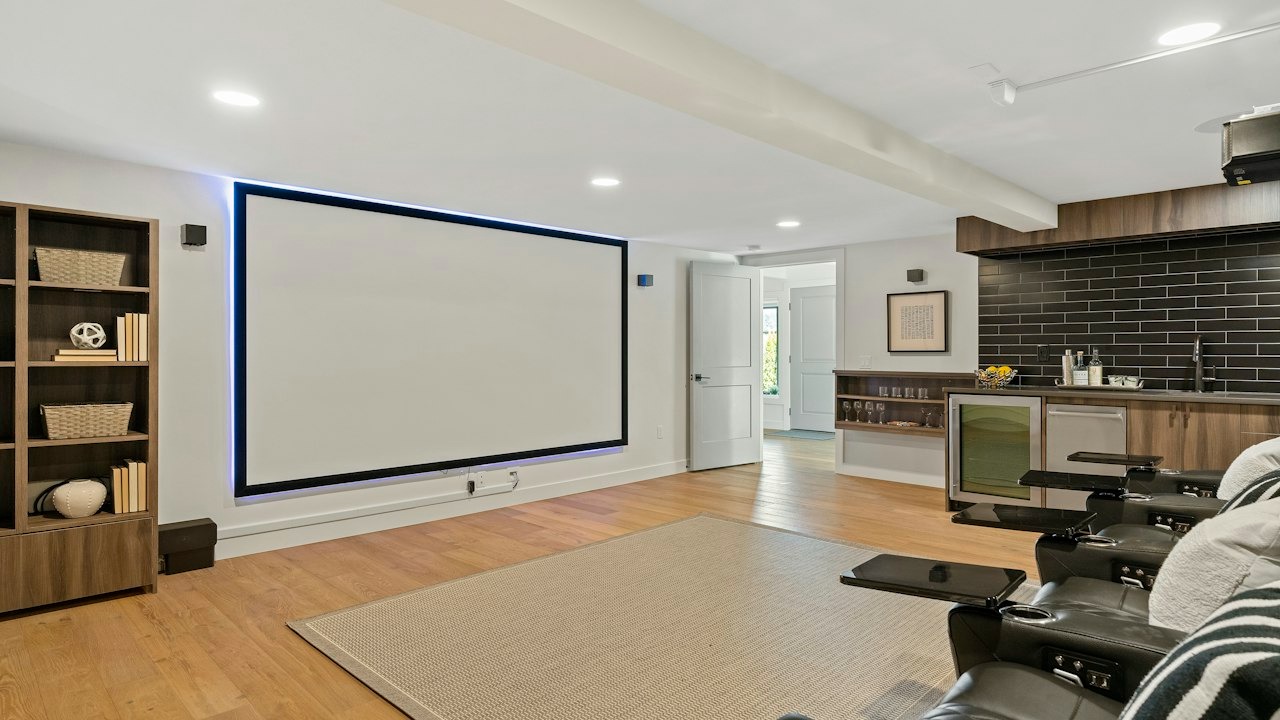
Most display comparisons begin with resolution, contrast, and price. Yet the first difference a household notices is often physical: one option occupies the wall all day, while another creates a large picture when people choose to watch. Neither approach is automatically better. A realistic choice starts with the size of the room, its light, the furniture you want to keep, and how often the screen is actually in use.
Consider what the wall does all day
A large television is always a visible object unless concealed with furniture or artwork. A projector paired with a retractable screen can leave the wall available for a different purpose. On the other hand, a fixed screen remains prominent too. Decide whether an always-present display fits the room before looking at specifications. This is as much an interior-design decision as a technical purchase.
Every large image changes the proportions of a room. The screen becomes a focal point even when nobody is watching, unless it can retract or blend with surrounding surfaces. Try outlining the intended picture with removable tape and viewing the room from the door, sofa, and dining area. If the arrangement feels cramped during the day, seek a layout improvement before buying a bigger image.
Find the comfortable image size
The largest image you can buy is not necessarily the one you will enjoy from your current sofa. Measure your seating distance and outline candidate sizes with removable tape. Check whether children sitting on the floor or guests at the end of the couch can see comfortably. A 4K RGB laser UST projector may make a large picture possible near the wall, but its installation geometry must still match the cabinet and screen.
A technically correct installation can still frustrate its owners. Remote-control confusion, a speaker that blocks the lower edge of the picture, and cables crossing a walking route are common examples. Make a short rehearsal of powering on the system, switching sources, adjusting lights, and shutting it down. Let someone who did not install it perform the same sequence; their questions are valuable design feedback.
Assess daylight honestly
Televisions emit light directly; projection reflects light off a surface. This difference matters greatly in rooms with exposed windows. Projectors can look striking in controlled conditions, but bright ambient light makes dark scenes harder to distinguish. Test at the time of day you actually watch most often. Blinds or a compatible ALR screen can help, but they do not erase the basic physics.
Sound often reveals a room’s weaknesses before the picture does. Bare walls create reflections, high ceilings can make dialogue less direct, and open doorways let music reach the rest of the house. Soft furnishings help but cannot replace sensible speaker placement. Listen from the least favorable seat at ordinary volume. If words are hard to understand there, changing a picture setting will not improve the experience.
Compare the complete installation
A television needs an appropriate stand or wall mount and safe cable access. Projection may require a compatible screen, additional furniture planning, precise positioning, and light control. If considering a 4k projector for home theater use, include those items in the budget. Compare finished systems rather than the price of a single device. A complicated installation can cancel out an apparent bargain.
Screen material is a system choice rather than a decorative finish. Gain, directional behavior, surface flatness, and compatibility with short or long projection distances affect the result. Read the screen specifications alongside those of the projector. A surface promoted for ambient-light rejection may be effective only for certain incoming-light directions; it is not a universal remedy for a sunny window.
Understand different viewing habits
Quick daytime news or short background viewing might reward instant convenience. Dedicated films and scheduled sports events can justify a larger screen and some preparation. Many households do both. Think about who operates the equipment, whether people regularly switch sources, and whether the display is used for casual multitasking. The best option is the one that suits those habits most of the week.
Be realistic about maintenance and future changes. Keep ventilation clear, avoid putting drinks next to electrical equipment, and leave access to HDMI or power connections. Furniture moves, streaming services change, and family habits evolve. The best installation is not necessarily the most hidden or complex; it is one that can be adjusted without disassembling the room or calling someone for every small change.
Do not overlook sound and reflection
A larger picture shifts attention toward the audio system. Check dialogue clarity and speaker placement, particularly if an ultra-short-throw device shares a cabinet with a soundbar. Reflections from furniture and walls can affect perceived contrast. Both display types benefit from careful room planning, though projection is generally more sensitive to light that falls directly on the screen.
A comparison is useful only when the viewing conditions are stated. The same display may look powerful after sunset and washed out at noon. Use the lighting arrangement that resembles a normal weekday, then repeat a familiar scene without changing the source. That exercise separates genuine improvements from the effect of a carefully staged demonstration and helps avoid spending extra money on a feature you will rarely see.
Choose flexibility or immediacy deliberately
Projection’s appeal often includes scale and a less permanent wall presence; television’s appeal often includes predictable performance in bright conditions and simple daily use. A household can reasonably value one advantage much more than another. Write down the two benefits that matter most and the compromises you can accept. That will narrow the decision faster than comparing lengthy feature lists.
The numbers on a product page describe several different systems at once. Resolution is not refresh rate, light-source design is not automatically color accuracy, and peak brightness is not the same as visible contrast in a bright room. Make a small table of the two or three qualities that matter to your household. Then compare evidence for those qualities rather than rewarding whichever model presents the longest feature list.
The practical takeaway
The useful question is not which technology wins in the abstract. It is which complete setup improves your particular room. Outline the display size, consider daylight, account for installation costs, and imagine ordinary use. A space-first comparison leads to a decision that remains sensible after the novelty of the new screen fades.
READ ALSO: The Hidden Data Advantage Behind High-Performing Organizations